
By Mara Santos, Host Academy Editor, PinasBnb
Is This Business Right for You?
Before the logistics, a realistic gut check: what’s your property’s likely nightly rate for its area and type, what will it cost to get guest-ready, and can you commit to responding to guests reliably (or delegate that reliably)? Cost and income figures vary significantly by location and property type — treat any number you see cited, including elsewhere in this article, as a starting estimate to verify against your specific area, not a guarantee.
Choosing Your Property Type and Location
Beach houses, condo units, farm stays, and heritage or traditional homes all perform differently depending on the area and guest type you’re targeting — a condo near a business district draws a different guest than a beach house in a weekend-getaway destination. This is worth researching specifically for your property before pricing or listing it; a full location-by-location breakdown is outside the scope of this guide.

Registering and Complying
Requirements vary by location, business structure, and property type, but most hosts find themselves dealing with some combination of DTI business-name registration, BIR registration, and Barangay/Mayor’s permits at the local level — condo owners typically have an additional layer worth checking before listing at all. Treat this as a starting orientation, not a compliance checklist: confirm current, specific requirements with your LGU, the BIR, and (for condo owners) your condo administration, since these details are exactly the kind that change and vary by circumstance.
Listing on Airbnb — Your First Step, Not Your Only One
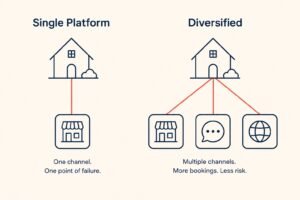
Signing up, listing your property, and going live on Airbnb is the fastest path to your first booking, and it’s genuinely the right place to start. Where most guides stop is here — as if a completed Airbnb listing is the finish line. It isn’t. It’s the beginning of a business that, if it depends entirely on one platform, carries all of that platform’s risk: fee changes, ranking changes, policy changes, none of which you control.
“Airbnb Business” or “Transient Rental”? Why the Words Matter
Depending on where you are and who you’re talking to, you might describe what you’re doing as an “Airbnb business” or a “transient rental” (or “transient house”) — and these aren’t just two names for the same thing. “Airbnb business” tends to describe the platform-and-listing side: signing up, pricing, guest reviews. “Transient rental” is the more established Philippine term for the underlying business of renting out a room or house short-term — including bookings that never touch Airbnb at all, arranged through Facebook, referrals, or word of mouth. If your property gets booked both ways, both terms apply to what you’re actually running.
Building a Business That Doesn’t Depend on One Platform
This is the part worth taking seriously before you’re several months in. A single-platform business has a single point of failure. Diversifying doesn’t mean abandoning Airbnb — it means recognizing where you’re currently dependent on things outside your control, and building something of your own alongside it:
- If your bookings-outside-Airbnb currently happen through Facebook and Messenger, with no structured way to track them → Getting Direct Bookings Through Facebook & Messenger
- If payment confirmation is manual and error-prone → Getting Paid Directly
- If you’re weighing Airbnb against other platforms, or wondering whether a direct channel makes sense → Airbnb Alternatives for Philippine Hosts
- If you’re managing this from outside the Philippines → Managing a Philippine Rental Business From Abroad
What Comes Next: Owning Your Direct Booking Channel
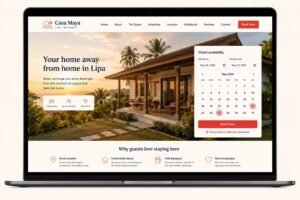
The common thread in all of the above is ownership: your own calendar, your own guest records, your own payment confirmations, and — eventually — your own booking channel that doesn’t depend on any single marketplace’s rules. See what a direct booking website looks like →
Frequently Asked Questions
How much does it cost to start?
It varies significantly by location and property type — get a specific estimate for your area rather than relying on a general figure.
Do I need a business permit if I’m just renting out one room?
It depends on your specific situation — location, scale, and how your property is set up all factor in, and requirements can differ between LGUs. Rather than assume a one-size-fits-all answer, check directly with your Barangay and city/municipal office and the BIR for what applies to you; we’ll also be publishing a dedicated compliance guide with more detail.
Is “transient rental” legally different from an “Airbnb business”?
The terminology itself isn’t a legal category — “Airbnb business” and “transient rental” are just different ways people describe the same general activity. What actually determines your registration and tax obligations is the specifics of your situation (location, income, business structure, property type), not which term you use. Confirm your specific obligations with the BIR, your LGU, and, where relevant, a qualified professional, rather than relying on general guides like this one for a definitive answer.
Can I run this business alongside a day job or while working abroad?
Yes, many hosts do — see Managing a Philippine Rental Business From Abroad specifically for hosts managing from abroad.